Free sample
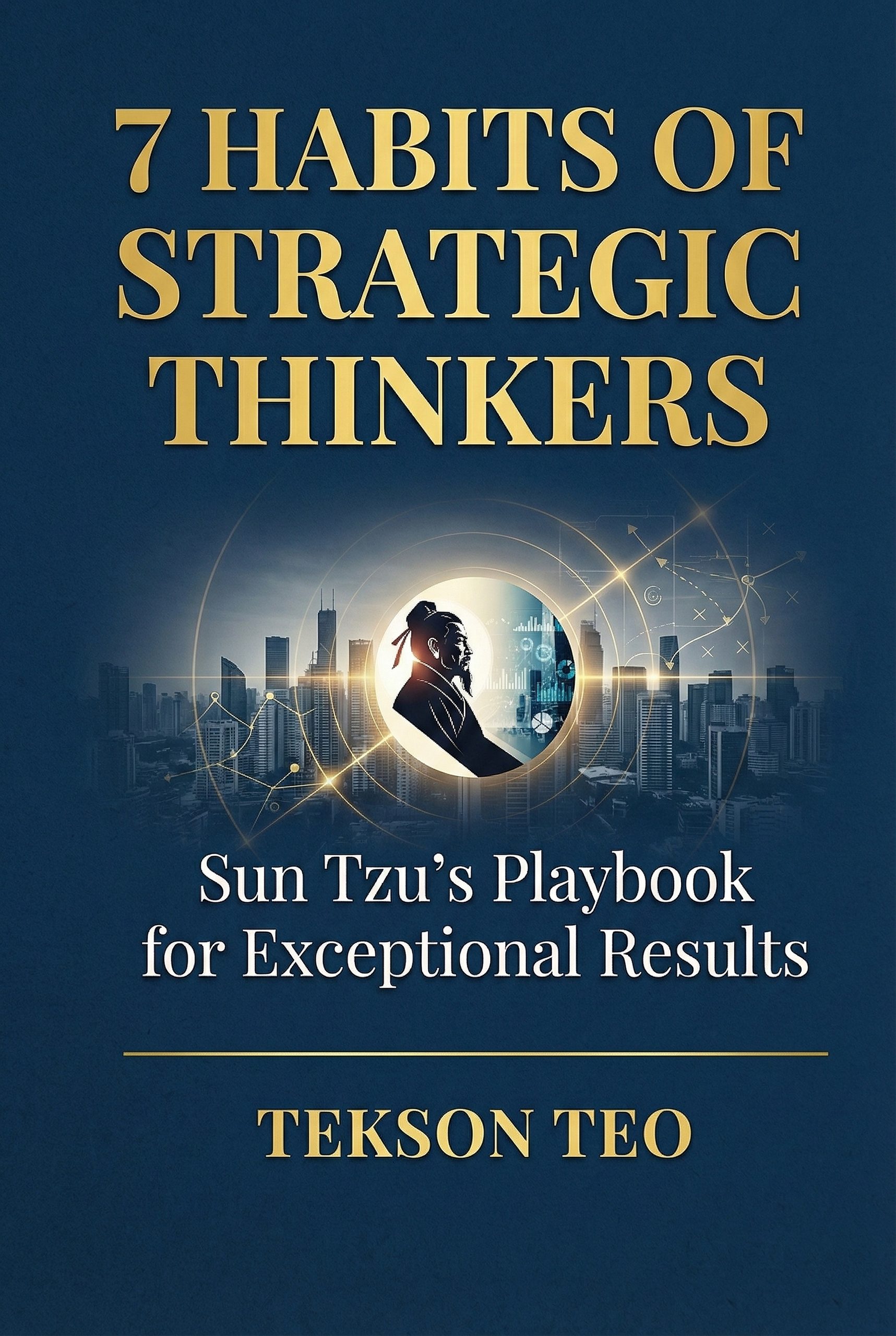
7 Habits of Strategic Thinkers
Sun Tzu’s Playbook for Exceptional Results
Read the preface and one complete chapter, Choose Your Battles. No sign-up needed.
Buying the ebook here gets you both EPUB and PDF, readable on any device, and directly supports my work. Prefer print? The book is on Amazon.
In this sample
Preface
Preface
You can be highly capable, hardworking, even brilliant — and still fail if your strategy is wrong.
Execution matters, but direction comes first.
If you must choose, choose a strategy before delivery. And to stay relevant over time, you must be both: good at what you do, and strategic about where you are going.
Strategy is not something added later. It becomes part of how you work, decide, and move.
That is why behind every enduring company lies a clear strategy. And behind every accomplished leader is the ability to think ahead — to make sound choices under uncertainty, to use timing well, and to move consistently in the right direction.
From Steve Jobs and Masayoshi Son to everyday leaders across industries, strategic thinkers stand out. They cut through noise, see patterns others miss, and stay focused on what truly matters when others are distracted by urgency. Working hard alone is not enough.
This also explains why, within organizations, strategic thinkers are entrusted with greater responsibility. They influence key decisions, shape long-term direction, and steady others in times of change — not because they speak the loudest, but because they see the furthest.
Strategic thinking, therefore, is widely recognized as a core leadership capability — a signal of readiness, potential, and long-term success.
And yet, despite its importance, there is a striking gap. Very few people are truly good at it. Research consistently shows that only about 4% to 7% of leaders are perceived as strong strategic thinkers.
This gap may be surprising — but it reveals a remarkable opportunity.
By simply picking up this book, you are already among the small group of people who want to think more strategically. If you belong to this minority — or aspire to join it — this gap becomes your advantage.
In a world that rewards speed over depth, efficiency over insight, and activity over reflection, the ability to think strategically is a rare and enduring edge.
Strategic thinking is not about being clever. It is about seeing clearly, choosing wisely, and moving early — before pressure forces your hand.
The real question, then, is this:
How do you become more strategic — or better still, join the small group of leaders who excel at it? And why do so few ever succeed?
To answer this, we must first understand why the gap exists.
What may surprise you is this: despite its importance, many people struggle to explain what strategy actually is. If you lack clarity about what something means, it is almost impossible to apply it well, let alone make it work for you.
From my years of running businesses and advising companies across different countries, I have observed a recurring pattern.
Many leaders are unclear about what strategic thinking truly means. Many treat strategy as something separate — reserved for annual planning, major initiatives, or moments of crisis. And even those who value strategy often lack practical ways to develop the skill consistently.
These challenges tend to fall into three broad areas.
First, a lack of clarity.
There is no widely agreed-upon definition of strategic thinking. Ask ten business leaders what it means, and you are likely to receive ten different answers. Many people struggle not because they lack intelligence or experience, but because the concept itself feels abstract and elusive.
One aim of this book is to restore that clarity — to explain strategic thinking in simple language, and to show how it can be cultivated as a practical, everyday capability rather than a mysterious talent.
Second, seeing strategy as something separate.
A common misconception is that strategy matters only in big moments — annual plans, crises, major launches, mergers, or competitive battles. The truth is the opposite. Strategic thinking is most powerful when it is continuous. It creates real advantage when it is woven into everyday decisions, not stored away for once-a-year conversations or emergencies.
Third, a lack of practical application.
There is no shortage of strategic tools. Most leaders have encountered them at some point. The problem is not access, but use. Strategic tools work only when applied consistently, yet many people treat strategic thinking as an occasional activity — something they turn to now and then, rather than a regular discipline embedded in daily work and decision-making.
This book approaches strategic thinking differently.
It treats it not as an event, but as a habit — something you practice daily, so that clarity is available when pressure arrives.
One of the most effective ways to develop strategic thinking is to make it habitual.
You do not turn to it only when circumstances become urgent — during a crisis or a critical planning meeting. You practice it day in, day out, until it becomes a second instinct.
When something truly matters, strategic thinking no longer feels forced or deliberate. It shows up naturally — ready to serve you when you need it most.
It is much like learning a sport. Skills practiced regularly become second nature. When pressure rises, you do not panic. Your training carries you.
That is exactly what this book is designed to help you build.
Wisdom of the Art of War
In shaping this framework, I drew from many disciplines — modern management, cognitive psychology, behavioral science, and leadership research.
But the deepest insights came from a much older source: The Art of War by Sun Tzu.
Written more than 2,500 years ago, it is far more than a military text. It is a timeless study of human nature — of clarity and decision-making, positioning and timing, and the psychology of advantage.
Its power lies in its simplicity.
Sun Tzu teaches us to win with wisdom rather than force; to conserve energy instead of scattering it; and to position ourselves so that success becomes easier, not harder.
When these ancient principles meet modern strategic thinking, something powerful emerges — a practical blueprint for navigating complexity with clarity and calm.
This forms the foundation of the 7 Habits of Strategic Thinkers: a set of essential practices designed to help you find clarity, position yourself wisely, focus your energy, build momentum, master timing, manage perception, and move through life with greater effectiveness and ease.
In the Introduction that follows, you will find an overview of these seven habits — and how each one strengthens your ability to think strategically, act decisively, and create better outcomes, both at work and in life.
This book is your guide to developing these habits.
May it help you think more clearly, move more purposefully, and walk your path with the quiet confidence of a true strategist.
Habit 3
Choose Your Battles
Win Only Where It Matters
One of the greatest obstacles to strategic thinking is not a lack of intelligence or effort. It is over-engagement.
People work too hard. They fight too many battles at once. And in the constant struggle, there is no breathing space left to see beyond what is immediately in front of them.
Most people do not lose in life because they are lazy. They lose because they are fighting too many battles simultaneously.
This brings us to one of Sun Tzu’s most important teachings—deceptively simple, yet profoundly strategic:
“Those who know when to fight and when not to fight win.”
Victory is not earned by fighting more.
That is why choosing the right battle is always at the top of a strategic thinker’s mind.
They fight only battles worth winning—and refuse those that drain strength, scatter focus, or pull them into endless struggle.
This principle shaped ancient warfare, but its relevance today is just as powerful.
Organizations rise or fall not by effort alone, but by what they choose not to fight.
In 2009, as messaging companies rushed to add more features—games, stickers, social feeds, payment tools—one company made a radically different choice.
They chose to fight only one battle: to make messaging fast, simple, and reliable.
No advertisements. No clutter. No distractions. Just clean, secure communication.
While competitors spread themselves thin, this company said no—again and again—to anything that did not serve its core mission. With a remarkably small team, they focused relentlessly on speed, stability, and user experience.
That discipline—choosing one battle and defending it with total commitment—built a product used by billions and ultimately valued at $ 19 billion.
This is the story of WhatsApp, one of the most widely used messaging platforms in the world.
They did not win by doing more. They won by refusing battles that did not matter.
But this principle is not reserved for CEOs or entrepreneurs. It is a discipline every individual must learn.
You and I face “battles” every day: work demands, difficult people, tempting opportunities, emotional triggers, and internal doubts.
Most people exhaust themselves by reacting to everything—treating every issue as urgent, every disagreement as personal, every opportunity as mandatory.
That is not courage. It is a recipe for defeat.
And yet, knowing that we should choose our battles is very different from actually doing so.
In real life, battles rarely announce themselves clearly. Some appear profitable but slowly drain us. Some feel too important to walk away from. Some trap us between fear, obligation, and exhaustion.
This was exactly the dilemma that troubled Tom.
The Battle Too Costly to Win
Tom ran a media agency whose biggest client contributed half of the company’s revenue.
On paper, this client was his lifeline. But over time, power had twisted the relationship.
The client became increasingly demanding — calling at odd hours, expecting instant responses, pushing Tom far beyond the contract. What began as a partnership slowly turned into a form of control.
“It’s too big a client to lose,” he told me.
But beneath that fear was a truth he had avoided for months: It was also too painful a client to keep.
Every time he thought about ending the relationship, a knot formed in his stomach.
What if replacing the revenue took months? What if the team suffered? What if he made a mistake?
He was trapped between financial dependence and emotional exhaustion — a place many entrepreneurs quietly endure but seldom talk about.
When he finally came to me, he wasn’t looking for motivation. He was looking for clarity.
So I asked him a question drawn from the spirit of The Art of War — one that cuts through fear and confusion:
“Are you fighting a battle that will cost you too much — even if you win?”
Tom paused.
For the first time, he examined the situation strategically instead of emotionally.
His smaller clients each brought in less revenue, but together they brought far more value: healthy boundaries, predictable workflows, stability, peace.
By contrast, this one “big client,” despite the money, was draining him of energy, sleep, patience, and joy.
It wasn’t a client relationship anymore — it was a battlefield he had already lost.
With clarity, Tom made the brave decision to walk away.
He redirected his strength toward his existing clients — and they began referring new ones. He restarted his marketing with a focus he hadn’t felt in years.
Within months, the revenue was fully replaced.
But what he gained was far more valuable: a business he could breathe in, a team he could lead calmly, and a life he could live with steadiness and control
Some battles look profitable but are quietly destructive. Winning them drains you faster than losing them ever could.
Strategic thinkers do not fight every battle.
They fight the ones that strengthen their life and position — and walk away from the ones that slowly consume them.
Battles You Must Not Fight
Before deciding which battles to fight, the first step is to eliminate the battles you should not fight—now, or ever.
Clarity often comes not from addition, but from elimination. For this, one of the most critical skills we must develop is the ability to say no.
Focusing on what not to do is sometimes more powerful—and more liberating—than deciding what to pursue.
In strategy, saying no is not avoidance. It is a focus. It concentrates your strength and protects the ground that truly matters.
In a world that constantly urges us to do more, real mastery lies in restraint. To know what to avoid is to know where your power belongs.
Here are five battles strategic thinkers consistently refuse to fight.
1. Battles Driven by Ego — The Need to Be Right
Some battles arise not from principle, but from pride.
Someone questions your idea or your competence, and suddenly a reflex kicks in. You feel the urge to defend. To argue back. To prove that you are right.
But ego-driven battles rarely make you stronger.
I have fallen into this trap myself.
During a routine meeting, a colleague questioned my proposal. There was nothing hostile about it—just a different perspective. Yet my ego heard a threat.
Before I realized what was happening, I was defending every detail, trying to “win” the moment.
I won the argument. But I lost trust. I lost openness. And I damaged psychological safety.
A small ego trigger had quietly turned a simple conversation into an unnecessary war.
This happens more often than we care to admit. And when you learn to check your ego, you discover something liberating: you can walk away from many battles without losing anything that truly matters.
In doing so, you reclaim space—for clearer thinking, better relationships, and the battles that are actually worth fighting.
2. Battles You Cannot Win — No Matter How Hard You Try
Some battles drain you not because you lack ability, effort, or intelligence, but because victory is impossible under conditions far beyond your control.
The signs are often clear: Expectations are unclear; rules keep shifting; The other party holds all the leverage. No amount of skill can overcome a game designed for you to lose.
I once worked with a partner who constantly changed the terms of our agreement. Every attempt to “fix” the relationship only moved the goalposts further.
Eventually, the truth became undeniable: I was fighting on terrain I could never control.
And when the ground does not support your advance, you do not push harder. You reposition.
Strategic retreat is not failure. It is the discipline of protecting your strength for battles that matter—even when, on the surface, it appears you are losing.
3. Battles That Distract You from Your Real Goal
Some battles do not directly hurt you. They pull you sideways.
You may even win them—at the cost of losing momentum in the battles that truly matter.
A tempting opportunity. A “quick favor.” A side project that feels interesting and harmless. Over time, these distractions dilute momentum and fracture focus.
I once agreed to help a friend overseas with his business—just a favor. It slowly expanded into multiple meetings, countless messages, and a steady drain on attention.
Meanwhile, my core project began to slip. I was not losing because the work was difficult. I was losing because my energy was dispersed.
Not every opportunity is your opportunity. Not every yes is strategic.
Strategic thinkers fiercely guard their focus—because focus is not just about effort, but about direction.
4. Battles Triggered by Emotion — Not Reason
Some battles begin not with facts, but with emotion—irritation, insecurity, impatience, or stress.
A silence you misread. A message that arrives at the wrong moment. A tone that feels off. Emotion flares, and suddenly there is an urge to respond, defend, or push back.
But emotional urgency is rarely strategic.
Once, I sent a proposal to a client and heard nothing for two days. In the absence of information, my mind filled the silence with assumptions.
Just as I was about to send a long, defensive message, his reply arrived: “Sorry for the delay—travelling. Great work.”
In an instant, the emotional storm disappeared.
Emotion wanted action. Reason needed time.
Strategic thinkers learn to pause, not pounce.
5. Battles That Cost Too Much, Even If You Win
Some battles are winnable — but not worth the price.
You can push harder. You can outwork the other side. You can technically “win.” But the real question is: Is winning worth the cost?
Victory always demands payment — time, energy, emotional bandwidth, relationships, or peace of mind.
I once coached a manager determined to “fix” a difficult employee. He poured months into coaching, correcting, and monitoring.
He had the authority. But the battle drained him, and the employee barely improved.
Once he restructured the team and stepped back, clarity returned.
The battle was winnable. But winning it would have been too expensive. Perseverance is a strength —until it becomes self-sacrifice.
Strategic thinkers measure battles not by difficulty, but by return on effort.
Cultivate Habit 3: Choosing Your Battles
Choosing your battles is not a one-time insight. It is a daily discipline.
Each time you choose wisely, you preserve time, energy, and attention for the battles that truly deserve them. Over time, this discipline compounds—bringing greater clarity, effectiveness, and calm.
The following three practices will help you build that discipline.
Practice 1: Don’t Let Emotions Take Over
Ask yourself a simple question: Am I reacting?
Most unnecessary battles begin with an emotional reaction, not a strategic choice. Before you respond, pause for three seconds. If needed, step away—even briefly.
That pause interrupts impulse and creates space for clarity.
Then ask yourself:
- Is this worth my energy?
- Am I responding—or reacting?
- Will this move me forward, or pull me sideways?
Daily Practice
When triggered, pause.
Take one conscious breath and ask: “Is this a reaction—or a strategy?”
Act only when the answer is clear.
This small pause is often the difference between getting dragged into a battle and choosing not to fight it at all.
Practice 2: Secure Your Strategic High Ground First
In warfare, the side that holds the high ground controls the battle. From higher ground, you see further, move faster, and force the opponent to fight uphill—buying you time, space, and energy.
Your day works the same way.
Your “high ground” is your most important work: the actions that shape your future, build advantage, and move you toward long-term goals.
Most people begin their day on low ground—checking messages, clearing small tasks, responding to other people’s priorities. By the time they lift their heads, the day is already lost.
Strategic thinkers secure their high ground early.
They begin each day by identifying the one or two actions that matter most—the work that creates real leverage.
Once you hold this ground, everything else becomes easier to defend, delay, or decline.
Daily Practice
Each morning—before checking messages or responding to anyone—identify your strategic high ground for the day.
Ask yourself:
- What is the one action today that, if completed, will move me meaningfully closer to my long-term goal?
- What task creates advantage, not just activity?
- Which work requires clarity, focus, or fresh energy?
Then act deliberately:
- Block the first hours of your day and dedicate them to securing this high ground—no emails, no calls, no low-value tasks.
- Protect it like a general protects key terrain. When something tries to pull you away, ask: “Is this worth surrendering my high ground?” The answer is almost always no.
- Finish the high-ground action—or make a decisive advance. A small but strategic win early stabilizes everything that follows.
- Let smaller tasks fit around your high ground, not the other way around.
Over time, this single discipline rewires your default. You stop living reactively—and start leading your day from a position of advantage.
Practice 3: Conduct a Weekly “Battle Debrief”
In war, no general wins by fighting blindly.
Each battle, whether won or lost, provides intelligence — insights about terrain, timing, readiness, and mistakes to avoid.
Your week works the same way.
Without reflection, you repeat the same unproductive battles. With reflection, you sharpen your judgment and learn to choose your fights with precision.
Before ending your week, take three deliberate minutes to review your engagements:
- Which battles were truly worth fighting?
- Which ones drained me unnecessarily?
- Where did I react instead of respond?
- What patterns did I notice — in people, situations, or triggers?
- What did I gain by walking away from the wrong fights?
This simple debrief turns experience into strategy.
It helps you spot recurring traps and teaches you how to avoid them.
Over time, you begin to anticipate battles before they arise — and choose wisely.
Weekly reflection is not an administrative exercise. It is your intelligence report. It prepares you to enter the next week with clarity rather than chaos.
Daily Practice
Each evening, take one minute to note:
- One battle you chose well, and
- One battle you should avoid next time.
This daily awareness sharpens your instinct.
By the time you reach your weekly debrief, the patterns are already clear.
These micro-reflections compound over time, giving you the calm confidence of someone who knows exactly which battles strengthen them — and which ones to walk away from.
Reflection: Win by Fighting Only What Matters
Choosing your battles is one of the most important disciplines in strategy — and one of the hardest.
Emotions rise. Ego gets triggered. Opportunities tempt. Demands pull you in every direction. Without awareness, you end up fighting on every front and wondering why you feel exhausted.
But the truth is simple: You don’t have to fight everything. You only need to fight what matters.
When you pause before reacting, secure your strategic high ground, and reflect on your patterns each week, something shifts.
You stop scattering your strength. Your energy becomes focused, deliberate, and effective.
Strategic thinkers don’t win by fighting more battles. They win by fighting the right ones — the ones that strengthen their position, build advantage, and move them closer to their long-term goals.
Transition to Habit 4: Build Quiet Momentum
When you choose your battles wisely, you stop draining your strength. Your energy consolidates around what truly matters.
And when that focused effort repeats day after day, a powerful force begins to grow — quietly at first, then unmistakably.
It gathers direction. It builds speed. It becomes the momentum that carries you forward with less force and more flow.
This is the essence of the next habit: Build Quiet Momentum.
Enjoyed the sample?
The full book covers all seven habits, from Dare to Win to Flow Like Water, each with daily practices you can start the same day.
Buying the ebook here gets you both EPUB and PDF, readable on any device, and directly supports my work. Prefer print? The book is on Amazon.