Free sample
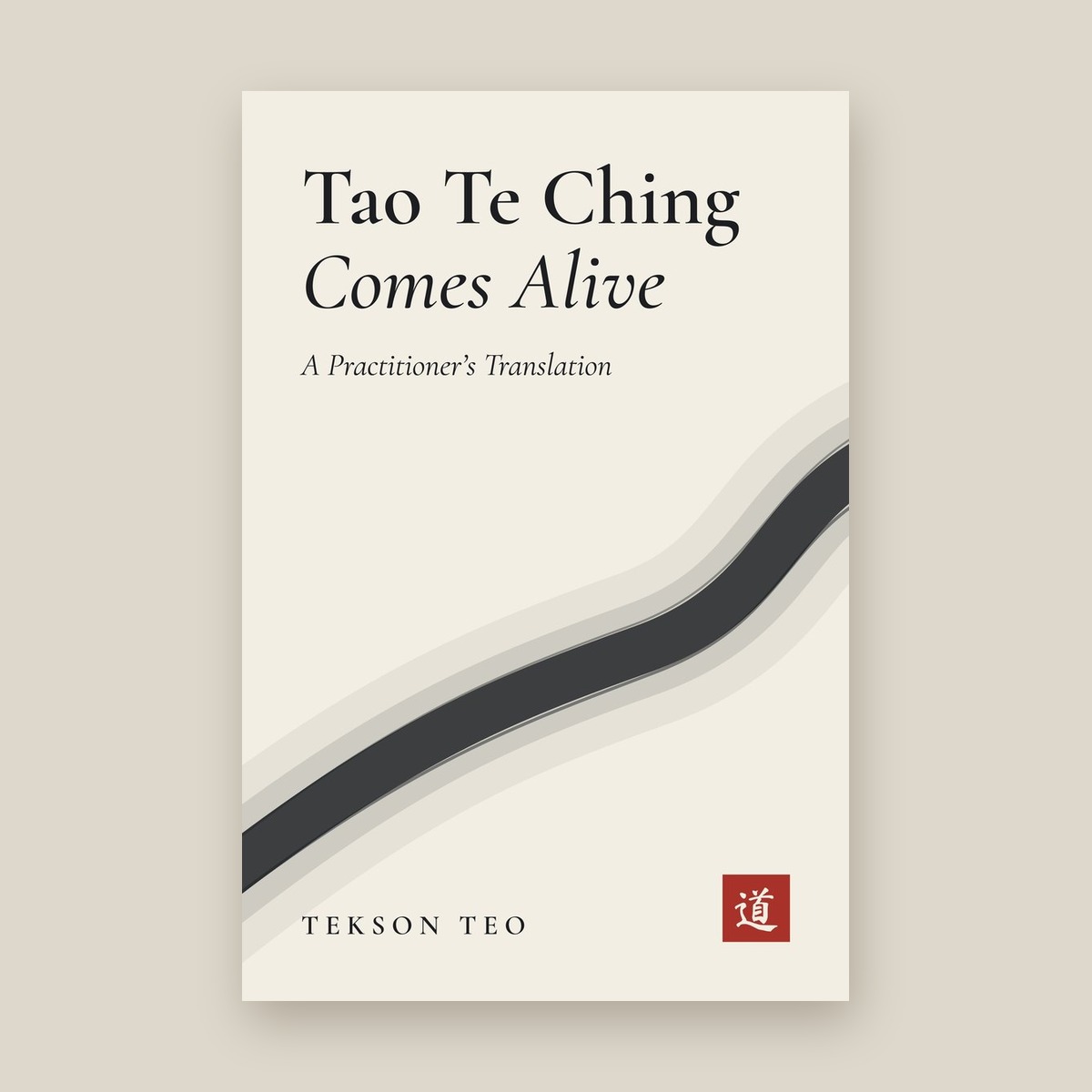
Tao Te Ching Comes Alive
A Practitioner’s Translation
Read the opening of the introduction and three complete chapters, each with the Chinese original and my notes. No sign-up needed.
Buying the ebook here gets you both EPUB and PDF, readable on any device, and directly supports my work. Prefer print? The paperback is on Amazon.
In this sample
From the introduction
Introduction
The Tao Te Ching is a small book. You can read its eighty-one chapters in an afternoon. Yet a single line can keep you company for years.
I have been reading it for decades, and it still surprises me. A passage that once puzzled me suddenly makes sense after an ordinary experience. A line I thought I understood shows me something new when life takes an unexpected turn. Sometimes the book helps me understand a difficulty; sometimes a difficulty helps me understand the book. Reading and living light each other up.
That is the spirit in which I offer Tao Te Ching Comes Alive.
Why a Practitioner’s Translation?
For most of my working life, I have been a management consultant. I have worked with thousands of leaders, from entrepreneurs to CEOs and senior executives, in Singapore, Malaysia, Thailand and China. Over those years, I watched Lao Tzu’s teachings play out in meeting rooms across Asia: insistence that hardened resistance, listening that opened a way forward, timing that mattered as much as the action itself, and leaders who were most effective when people barely noticed them.
I have also practised tai chi and qigong for many years, as exercise and as a philosophical pursuit. In practice, the teachings become physical. Tension restricts movement; softness allows a response. Balance is never fixed; it has to be found again and again.
But being a practitioner of the Tao doesn’t require a martial art or a boardroom. It means practising its teachings where we live: in how we speak and listen, how we raise our children, how we handle a setback, how we decide when to act and when to wait. That is why the notes in this book draw mostly on ordinary life: a child learning to walk, a swimmer learning to float, a gate that needed pulling rather than pushing.
Understanding a teaching in words is only the beginning. Its meaning deepens as we try it out in how we move, respond, work and live. My hope is that these pages will help you begin your own conversation with the book.
The introduction continues in the full book.
Chapter 11
The Emptiness That You Use
Thirty spokes converge on a single hub;
it is the space within
that makes the cart usable.
Shape clay into a vessel;
it is the space within
that allows it to be filled.
Cut doors and windows to make a room;
it is the space within
that makes the room habitable.
So, while being brings you benefits,
it is non-being that you use.
三十輻共一轂,當其無,有車之用。埏埴以為器,當其無,有器之用。鑿戶牖以為室,當其無,有室之用。故有之以為利,無之以為用。
Translator’s notes
當其無 — the space that makes it work
Look at a teapot. Most of us notice its round belly, the handle and the spout, perhaps the texture of the clay. But none of these is what the teapot is for. Its purpose lies in the one part we cannot see: the emptiness inside. Without it, however elegant the pot, there is nowhere for the tea to go. It is a piece of art, not a teapot.
Lao Tzu gives three examples: the hole in the hub that takes the axle, the hollow of the vessel, the space within the room. In each, the essential part is the part that isn’t there.
有之以為利,無之以為用 — substance and emptiness
These are the same pair, 有 and 無, that appear as being and non-being in chapters 1 and 2. Here I translate them as substance and emptiness, because we are looking at things we can hold.
Neither works alone. The emptiness in the teapot needs the clay around it; the space in a room means nothing without walls. Substance gives a thing its form; emptiness is what we use.
The balance runs through daily life. A dream needs a plan to stand on, and love needs gestures that show it. A conversation needs pauses for listening, and a schedule needs room for the unexpected.
見其無 — seeing what others don’t see
Once you start looking for emptiness, you see it everywhere. Money is something you can hold. What it gives you cannot be held at all: security, freedom, joy, a gift for someone you love. A person is more than their appearance, and what they leave unsaid often matters most.
Seeing the emptiness within the substance helps us see the true value of things.
Chapter 17
The Best of Leaders
The best of leaders—
their people merely know they exist.
Next are those their people
love and praise.
Next come those they fear.
Next come those they despise.
Where trust is insufficient,
distrust follows.
Unhurried, they treasure their words.
When the work is accomplished
and the task fulfilled,
their people say,
“We did it naturally.”
太上,下知有之。其次親而譽之。其次畏之。其次侮之。信不足焉,有不信焉。悠兮其貴言,功成事遂,百姓皆謂我自然。
Translator’s notes
太上,下知有之 — the best of leaders
A boss who is really in control doesn’t have to tell anyone. Their leadership is so natural that people know it is there, and little more. What people notice is that the work goes well: the direction is clear, help arrives when it’s needed, and they can get on with the job.
其次親而譽之⋯⋯其次侮之 — love, fear and contempt
Being loved and praised seems like the peak of leadership. Lao Tzu puts it second. A leader who is loved still has everyone’s attention on them. The best leader turns attention to the work and the people doing it.
Below that, it gets worse: leaders people fear, and at the bottom, leaders people despise. With each step down, the leader looms larger and the people grow smaller.
信不足焉,有不信焉 — trust breeds trust
Trust works both ways. A leader who doesn’t trust people checks everything, and people soon stop trusting the leader. Give people room to use their judgement, and be someone whose word holds, and trust grows on both sides.
悠兮其貴言 — unhurried, sparing with words
We saw in chapter 5 how a leader who speaks sparingly carries weight. Here Lao Tzu adds the word 貴 : such leaders treasure their words. They don’t spend them on constant instructions, promises they may not keep, or interventions no one needs. So when they do speak, people listen.
功成事遂,百姓皆謂我自然 — “we did it naturally”
This is the chapter’s quiet punchline. When the work is done, people are so pleased that they believe they did it all on their own. And in a sense, they did. The leader helped create the conditions, then stayed out of the way. That is non-doing in leadership: the better the leader, the less credit they need.
Chapter 76
Born Soft and Supple
A person is born soft and supple;
in death, they are hard and stiff.
Plants are born soft and tender;
in death, they are withered and dry.
Thus the rigid and unyielding
belong with death;
the soft and supple
belong with life.
An army that is rigid will not win;
a tree that is rigid will meet the axe.
The strong and mighty take the lower place;
the soft and yielding take the higher.
人之生也柔弱,其死也堅強。萬物草木之生也柔脆,其死也枯藁。故堅強者死之徒,柔弱者生之徒。是以兵強則不勝,木強則兵,強大處下,柔弱處上。
Translator’s notes
人之生也柔弱⋯⋯柔弱者生之徒 — signs of life
A newborn is soft and supple; at death, the body is stiff and hard. A green branch bends; a dead one snaps. In a young tree, water and nutrients flow freely; once it falls, it turns brittle and dry.
The same is true of our minds. Rigid views and fixed habits are signs that something in us is drying out. To stay soft is to stay alive.
是以兵強則不勝,木強則兵 — the rigid tree meets the axe
An army that cannot bend will not win. And the tallest, hardest tree is the first one the woodcutter chooses.
But softness isn’t evasion. Staying soft doesn’t mean running away from problems. It means engaging with them while keeping the ability to respond, adjust and recover.
強大處下,柔弱處上 — the soft rises to the top
Look at any tree. The hard trunk and roots sit below; the soft new shoots and leaves grow at the top. Lao Tzu reverses the usual ranking: the hard and strong go down, and the soft and yielding rise. Lasting strength is the kind that can still bend.
Enjoyed the sample?
The full book has all 81 chapters, each with the Chinese original and my notes.
Buying the ebook here gets you both EPUB and PDF, readable on any device, and directly supports my work. Prefer print? The paperback is on Amazon.